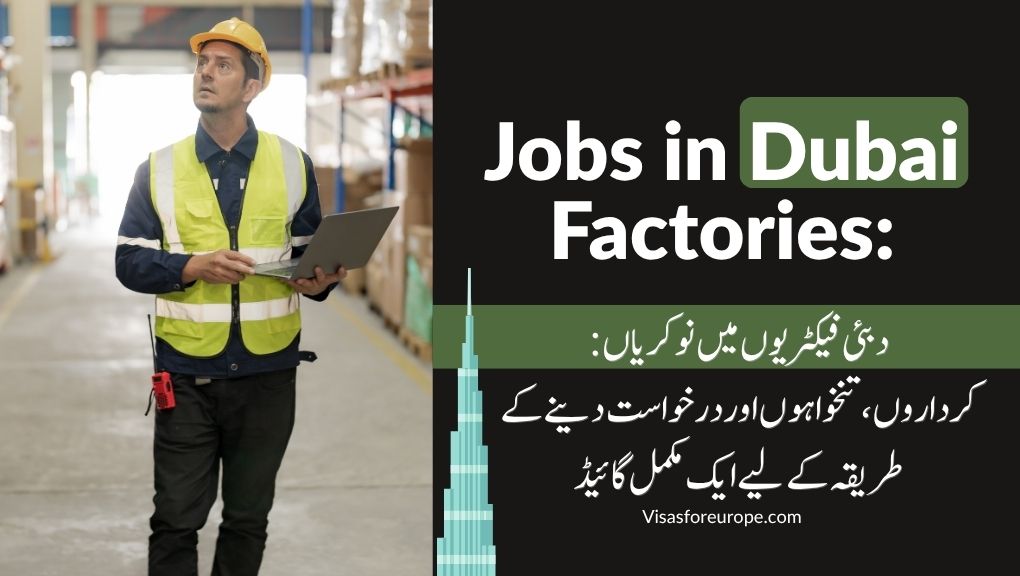
Dubai is known for skyscrapers and luxury shopping, but a large part of its economy runs on something less glamorous: manufacturing and industrial production. Behind every packaged food item, aluminium window, cable, pipe, plastic container, and piece of furniture made in the UAE is a factory floor full of skilled and semi-skilled workers.
That is why jobs in Dubai factories attract thousands of applicants every year from South Asia, Africa, the Philippines, and beyond. The work is steady and the entry barrier is lower than in many office roles. For many workers, it is also a path to supporting a family back home.
But the market has its share of misinformation, inflated salary promises, and outright scams. This guide covers what factory work in Dubai actually looks like: the types of factories, the roles available, realistic pay, legal requirements, and how to apply safely.
Why Dubai Is a Strong Destination for Factory Workers
Dubai’s government has spent decades diversifying the economy beyond oil, and manufacturing is a deliberate part of that plan. Several things make the city attractive to job seekers:
- Tax-free income. The UAE does not levy personal income tax on salaries, so more of your pay stays with you.
- Strong industrial infrastructure. Free zones and industrial clusters are built specifically for manufacturers.
- Regular demand for labour. Construction, food, packaging, and logistics keep factories busy year-round.
- Employer-provided benefits. Many factories offer accommodation, transport, and sometimes meals, which cuts your living costs.
- Regulated work environment. The UAE has formal labour laws, a wage protection system, and a government ministry that handles complaints.
Where Are the Factories? Key Industrial Areas in Dubai
Knowing where the work is helps you target your search. These are the main hubs:
Jebel Ali Free Zone (JAFZA)
One of the largest free zones in the region, home to thousands of companies. Factories here cover everything from steel fabrication to consumer goods and chemicals, thanks to the neighbouring Jebel Ali Port.
Dubai Industrial City
A purpose-built cluster for light and heavy manufacturing, including food processing, building materials, and machinery.
Dubai Investments Park (DIP)
A mixed-use zone with a good number of factories, warehouses, and labour accommodation nearby.
Al Quoz, Ras Al Khor, and Al Qusais
These older industrial districts host smaller and mid-sized workshops, fabrication units, packaging plants, and furniture makers. They are often a good starting point for entry-level workers.
Nearby Sharjah and Ajman
Many Dubai residents work in factories in Sharjah’s industrial areas, which are just a short commute away. Rents can be lower there, so some workers choose to live outside Dubai.
Types of Factories Hiring in Dubai
The kind of factory you work in shapes your daily routine, your skill requirements, and your pay. The major sectors include:
- Food and beverage processing: bakeries, dairy units, juice and water bottling, and packaged foods
- Plastic and packaging: moulding, printing, labelling, and carton production
- Metal and steel fabrication: welding, cutting, and assembling structural and decorative metalwork
- Building materials: cement products, tiles, aluminium and glass, and paint
- Electrical and cable manufacturing: wiring, switchgear, and lighting products
- Furniture and woodworking: carpentry, finishing, and upholstery
- Garments and textiles: stitching, cutting, and quality checking
- Chemicals, cosmetics, and cleaning products: blending, filling, and packing
Popular Factory Job Roles in Dubai
Factory work is not one job; it is a ladder. Here are the roles you will see most often, from entry level upward.
Entry-Level and Unskilled Roles
- Factory helper / general labourer: loading, unloading, cleaning, and assisting machine operators
- Packer / packaging worker: sorting, packing, and labelling finished goods
- Loader and warehouse assistant: moving stock between production and storage
Semi-Skilled Roles
- Machine operator: running and monitoring production machinery
- Production line worker: performing a repeated assembly or processing task
- Forklift operator: moving heavy pallets (a valid licence is usually required)
- Quality checker: inspecting products against set standards
Skilled and Technical Roles
- Welder, fitter, and fabricator: especially valued in metal factories
- Electrician and maintenance technician: keeping machines running
- CNC or industrial machine operator: often requires training or certification
- Mechanic: repairing production equipment
Supervisory and Professional Roles
- Production supervisor or line leader
- Quality control (QC) inspector or engineer
- Plant or production manager
- Health, safety, and environment (HSE) officer
If you are starting at the bottom, remember that many supervisors began as helpers. Learning a machine well and showing reliability can move you up faster than you might expect.
Realistic Salary Expectations
This is where many job seekers get misled, so let us be honest. Salaries vary by company, nationality, experience, and whether accommodation is included. The following are approximate monthly ranges commonly seen in the market. Treat them as a guide, not a guarantee:
| Role | Approx. Monthly Salary (AED) |
|---|---|
| General helper / labourer | 800 – 1,500 |
| Packer / production worker | 1,000 – 1,800 |
| Machine operator | 1,500 – 3,000 |
| Forklift operator | 1,800 – 3,000 |
| Welder / technician | 2,000 – 4,500 |
| Production supervisor | 3,500 – 7,000 |
| QC engineer | 4,500 – 9,000 |
A few points to keep in mind:
- Basic salary versus total package. Some offers include accommodation, transport, and food allowance. Others pay a higher cash figure but expect you to cover living costs. Always compare the full picture.
- Overtime. Under UAE labour rules, overtime is paid at a premium, and many factories offer extra shifts. This can raise your take-home pay noticeably.
- Check the offer letter. Whatever is promised verbally should appear in writing.
Basic Requirements to Get a Factory Job in Dubai
Requirements depend on the role, but most employers look for the following.
General Requirements
- A valid passport with enough remaining validity
- Good physical fitness, since many roles involve standing, lifting, or heat
- Basic English or Hindi/Urdu communication, depending on the workforce
- A willingness to follow safety rules and work in shifts
For Skilled Roles
- Trade experience (welding, electrical, machine operation, etc.)
- Certificates or diplomas where relevant
- A driving or forklift licence for those roles
- A trade test during hiring, which is common for technicians
Documents to Keep Ready
- Passport copy and passport-size photographs
- Educational and professional certificates
- Updated CV with work history
- Previous experience letters, if you have them
Understanding the Visa and Work Permit Process
A legitimate job in Dubai requires a proper work permit and residence visa, which the employer sponsors. This is where many people get confused, so here is how it works in plain terms:
- Job offer. The company issues an offer letter or contract.
- Work permit. The employer applies for a work permit through the UAE’s labour ministry (MOHRE).
- Entry permit. Once approved, an entry visa is issued so you can travel.
- Medical test and Emirates ID. After arrival, you complete a medical fitness test and register for your Emirates ID.
- Residence visa. The visa is stamped, and you begin work officially.
An important rule: under UAE law, recruitment costs are the employer’s responsibility. A genuine employer or licensed agency should not charge workers fees to place them in a job. If someone demands a large payment for a “guaranteed” visa, treat that as a serious warning sign.
How to Apply for Factory Jobs in Dubai: Step by Step
Here is a practical path you can follow:
- Prepare a clear CV. Keep it to one or two pages. List your skills, machines you have operated, and certifications.
- Search legitimate sources. Reputable job portals, company career pages, and licensed recruitment agencies are the safest options.
- Apply directly where possible. Many factories list vacancies on their own websites or social pages.
- Verify the recruiter. Check that an agency is licensed in your home country and that the employer is registered in the UAE.
- Prepare for interviews and trade tests. These may be on video call or in person. Brush up on your core skills.
- Read the contract carefully before signing. Confirm salary, working hours, accommodation, and contract length.
- Keep copies of everything. Offer letters, messages, and receipts protect you if something goes wrong.
How to Avoid Job Scams
Fake offers target hopeful applicants every day. Protect yourself by watching for these red flags:
- Upfront payment demands for visas, “processing,” or “security deposits”
- Offers that arrive without any interview or skills check
- Unrealistically high salaries for unskilled work
- Communication only through messaging apps, with no official company email
- Visit visas disguised as work visas. A tourist or visit visa does not allow you to work legally
- Pressure to decide immediately
You can also verify a job offer through official UAE government channels before paying or travelling. If you are unsure, ask the company for its trade licence details and confirm them independently.
Working Conditions and Your Rights
Knowing your rights helps you spot a good employer. Key points under UAE labour law include:
- Working hours. The standard limit is 8 hours a day or 48 hours a week, with extra time treated as overtime.
- Wage protection. Salaries are paid through a system that records payments electronically, so delayed or missing wages can be flagged.
- Midday break in summer. During the hottest months (mid-June to mid-September), outdoor work is banned during the afternoon. Factories must also manage heat inside workplaces.
- Paid leave and rest days. Workers are entitled to annual leave and weekly rest.
- End-of-service gratuity. After completing the qualifying period, you receive a gratuity payment when your contract ends.
- Safety standards. Employers must provide protective equipment and training.
If a dispute arises, you can approach the labour ministry’s complaint channels.
Life as a Factory Worker in Dubai
Beyond the job itself, think about the lifestyle:
- Accommodation. Many companies provide shared labour accommodation. Standards vary, so ask about room sharing and facilities before accepting.
- Transport. Company buses are common for industrial areas, saving you commuting costs.
- Climate. Summers are extremely hot. Factories are often air-conditioned, but outdoor yards and loading areas are not.
- Community. Dubai’s workforce is multicultural, and you will likely find colleagues from your own country.
- Cost of living. Food and transport can be affordable if you budget well, which helps you save and send money home.
Tips to Grow Your Career in a Dubai Factory
Do not treat the first job as the final destination. These habits help you advance:
- Learn a technical skill. Operators and welders earn considerably more than general helpers.
- Get certified. Forklift, safety, and trade certifications improve both pay and job security.
- Improve your English. Better communication opens supervisor roles.
- Be punctual and safety-conscious. Reliability is noticed quickly.
- Save consistently. Even a modest monthly saving builds up over a contract.
Conclusion
Jobs in Dubai factories can be a real opportunity: steady demand, tax-free income, and clear routes to better roles if you build your skills. The key is to go in informed. Know which industrial areas hire, understand realistic salaries, apply only through verified channels, and never pay for a visa that an employer should be sponsoring.
With the right preparation and a healthy dose of caution, a factory role in Dubai can become a stable foundation for your career and your family’s future.
Frequently Asked Questions (FAQ)
1. Do I need experience to get a factory job in Dubai?
Not always. Entry-level roles like helper or packer often hire without experience, though skilled positions such as welder or machine operator need proven skills.
2. What is the average salary of a factory worker in Dubai?
Entry-level workers commonly earn roughly AED 800 to 1,800 a month, while skilled technicians and supervisors earn more. Accommodation and overtime can change the total significantly.
3. Is accommodation provided by factories in Dubai?
Many employers provide shared accommodation or a housing allowance, but this varies. Confirm it in your written offer before accepting.
4. Can I work in Dubai on a visit visa?
No. A visit or tourist visa does not permit employment. You need an employer-sponsored work permit and residence visa.
5. Should I pay an agent to get a factory job?
Under UAE rules, recruitment costs should be borne by the employer, not the worker. Be very cautious if anyone asks you for large upfront payments.
6. Which areas in Dubai have the most factory jobs?
Jebel Ali, Dubai Industrial City, Dubai Investments Park, Al Quoz, Ras Al Khor, and Al Qusais are major hubs, with nearby Sharjah also offering many opportunities.
7. How long is a typical factory work contract?
Contracts commonly run for one to two years and can be renewed. Check the exact term and conditions in your contract.
Note: Salaries, visa procedures, and labour regulations change over time. Always verify current rules with official UAE government sources before making decisions.