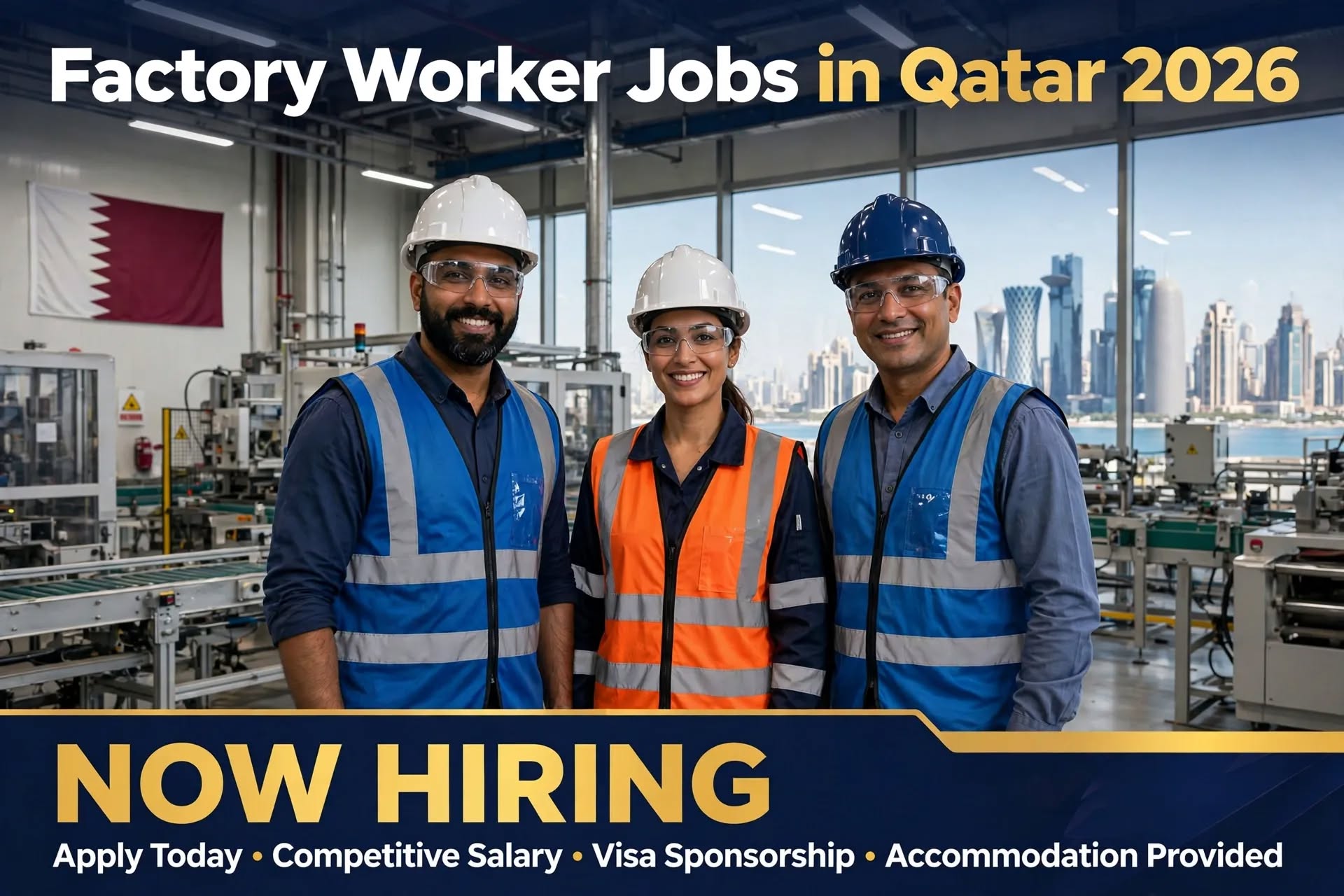
Qatar is one of the wealthiest countries per capita in the world, and its economy keeps growing well beyond oil and gas. Behind the skyscrapers of Doha and the stadiums built for the FIFA World Cup, there is a large industrial base of plants producing steel, cement, plastics, chemicals, food, packaging and building materials. Every one of those plants needs people on the floor, and that is where factory worker jobs in Qatar come in.
For many job seekers in South Asia, Southeast Asia and Africa, a factory position in Qatar is a realistic way to earn a steady, tax-free income, send money home, and gain international work experience. But it is also a market where mistakes can be costly. Fake agents, unclear contracts and unrealistic promises are real risks.
This guide walks you through everything you need to know: what factory jobs exist, what they pay, which documents you need, how the visa process works, where to look for genuine openings, and how to protect yourself. Read it from start to finish before you spend a single rupee, dollar or dinar on any recruitment process.
Why Qatar Is Attractive for Factory Workers
A Strong and Diversifying Economy
Qatar’s government has been investing heavily in industrial diversification under its national development strategy. The goal is to reduce dependence on hydrocarbons by growing manufacturing, logistics, food security and construction materials. This means steady demand for production workers, operators, packers, helpers and technicians.
Read More: Hotel Staff Jobs in Qatar
Tax-Free Income
Qatar does not charge personal income tax on salaries. What you earn under your contract is what you take home, apart from any agreed deductions. For workers who plan to save and remit money, this is a major advantage.
Employer-Provided Benefits
Many industrial employers provide a package that goes beyond basic pay. Depending on the company, this can include:
- Accommodation in a labour camp or shared housing
- Transportation between the camp and the factory
- Food allowance or meals on site
- Medical coverage and work-injury protection
- Annual air ticket to your home country
- End-of-service gratuity after completing the qualifying period
Always confirm these benefits in your written contract, not just in a verbal promise.
Types of Factory Worker Jobs in Qatar
“Factory worker” is a broad label. Here are the most common categories you will see advertised.
1. General Production Worker / Helper
This is the most common entry-level role. Duties include loading raw materials, feeding machines, sorting finished goods, cleaning the work area and supporting senior operators. No formal qualification is usually needed, but physical fitness and discipline are essential.
2. Machine Operator
Machine operators run equipment such as cutting machines, moulding machines, presses, filling lines or CNC units. Employers prefer candidates with previous experience or a technical certificate (ITI, diploma or equivalent). Pay is higher than for general helpers.
3. Packing and Packaging Worker
Food, beverage, plastics and household-goods factories need workers to pack, label, seal and palletise products. Speed, accuracy and attention to hygiene standards matter most here.
4. Quality Control (QC) Assistant
QC assistants inspect products, record measurements, flag defects and follow quality checklists. Basic English, numeracy and attention to detail are required.
5. Welder, Fabricator and Fitter
Steel and metal fabrication workshops hire skilled tradespeople. Candidates may be asked to take a practical trade test, and certifications improve both selection chances and salary.
6. Forklift Operator and Warehouse Staff
Most factories have an internal warehouse. A valid forklift licence and safety training can set you apart from other applicants.
7. Maintenance Technician
Electricians, mechanical technicians and HVAC specialists keep plant machinery running. These jobs need relevant trade qualifications and often several years of experience.
8. Supervisor and Line Leader
With experience, you can move up to supervising a production line. These roles need strong communication skills, English proficiency and leadership ability.
Major Industries Hiring Factory Workers in Qatar
Knowing which sectors hire the most helps you target your applications.
- Food and beverage processing: dairy, bakery, bottled water, juices and snacks
- Plastics and packaging: bottles, films, containers and industrial packaging
- Building materials: cement, bricks, precast concrete, tiles, glass and steel bars
- Chemicals and petrochemicals: fertilisers, polymers and industrial chemicals
- Metal fabrication: structural steel, pipes, ducting and fittings
- Furniture and woodwork: workshops serving the construction and hospitality sectors
- Textiles and garments: limited but present, mostly uniforms and linen
- Pharmaceutical and consumer goods: smaller but growing, with stricter hygiene standards
Key Industrial Zones in Qatar
Most factory jobs are concentrated in a few well-known areas.
Doha Industrial Area
Located south-west of Doha, this large zone hosts hundreds of workshops, warehouses and small to mid-sized factories. It is home to many fabrication, auto-related and general manufacturing units.
Mesaieed Industrial City
Mesaieed, south of Doha, is one of the country’s main industrial hubs. It hosts heavy industries including petrochemicals, metals and energy-related operations, along with supporting service companies.
Ras Laffan Industrial City
Primarily known for liquefied natural gas, Ras Laffan also supports a wide chain of contractors and suppliers. Most direct hiring here is for technical and specialised roles, but support jobs exist too.
Umm Al Houl and Other Emerging Zones
Newer economic and industrial zones are being developed to attract manufacturers. As these zones grow, so does the number of production jobs.
Salary Expectations: How Much Does a Factory Worker Earn in Qatar?
Salaries depend on your role, skills, experience, nationality-based contracts, and the employer. The figures below are rough, indicative ranges based on commonly reported market levels. Always verify the exact amount in your offer letter and contract.
| Role | Approximate Monthly Basic Pay (QAR) |
|---|---|
| General helper / labourer | 800 – 1,300 |
| Production worker | 1,000 – 1,600 |
| Packing worker | 1,000 – 1,500 |
| Machine operator | 1,500 – 2,500 |
| Forklift operator | 1,400 – 2,200 |
| Welder / fitter | 1,600 – 3,000 |
| QC assistant | 1,800 – 3,000 |
| Maintenance technician | 2,500 – 4,500 |
| Supervisor | 3,500 – 6,000 |
Understanding Your Pay Package
A job offer might list basic salary, accommodation allowance, food allowance, and transport allowance separately. Two offers with the same total can differ greatly in value depending on whether housing and food are provided free. Ask clearly:
- What is the basic salary?
- Is accommodation provided free, or is an allowance paid?
- Are food and transport included?
- How is overtime calculated?
- When is salary paid, and through which method?
Overtime and Extra Earnings
Factories often run shifts, and overtime can significantly raise your monthly income. Qatari labour law sets rules for working hours and overtime pay, so keep a record of your hours and check your payslip.
Eligibility and Requirements
While every employer has its own criteria, most factory worker positions share a common set of requirements.
Basic Requirements
- Age: typically between 21 and 45 years
- Education: basic literacy for helpers; technical certification for skilled roles
- Experience: none to two years for entry-level roles; three or more years for operators and technicians
- Physical fitness: ability to stand for long hours and lift moderate weights
- Language: basic English or Arabic helps; Hindi, Urdu, Nepali, Bengali and other community languages are common on shop floors
- Medical clearance: passing a pre-departure and in-country medical test
Documents You Should Keep Ready
- Valid passport (at least 6 months of validity, preferably more)
- Passport-size photographs with a white background
- Educational and trade certificates
- Experience letters from previous employers
- Police clearance certificate
- Medical fitness report
- Driving or forklift licence, if applicable
Keep both physical and digital copies of every document.
Step-by-Step Process to Get a Factory Job in Qatar
Step 1: Decide Your Role and Build a Simple CV
Choose the role that matches your skills. Prepare a one-page CV that lists your work experience, skills, certificates and contact details. Keep it clean, honest and free of exaggeration.
Step 2: Search Through Genuine Channels
Look for openings via:
- Licensed recruitment agencies registered with your home country’s government
- Official government employment portals in your country
- Direct company career pages of Qatari manufacturers
- Reputable job platforms that verify employers
- Company job fairs and overseas recruitment drives
Step 3: Apply and Attend the Interview
Interviews for factory roles are often short and may be held online or in person. Some employers also conduct a trade test for skilled roles such as welders or machine operators. Be prepared to explain your previous duties and the machines you have worked with.
Step 4: Receive the Offer Letter and Contract
Before agreeing to anything, read the offer carefully. It should state your job title, salary, allowances, working hours, contract duration, benefits and termination conditions. If a recruiter refuses to give you a written contract, treat that as a warning sign.
Step 5: Complete the Medical and Biometrics
Under Qatar’s current system for many source countries, workers often complete medical tests and biometrics at an authorised centre before travel. The Qatar Visa Centre (QVC) operates in several countries to streamline this process. Check the official Qatar visa and Ministry of Interior websites for your country’s specific steps.
Step 6: Work Visa Approval
Your employer applies for your work visa and entry permit in Qatar. Once approved, you receive your visa details and can book your flight, which in many cases is paid by the employer.
Step 7: Arrival, Residence Permit and Qatar ID
After you arrive, the employer arranges your Residence Permit (RP) and Qatar ID. Your contract is registered with the authorities, and your salary should be paid through the Wage Protection System.
Understanding Qatar’s Labour Rules and Worker Rights
Qatar has introduced several labour reforms over the last few years, and knowing them can protect you.
Wage Protection System (WPS)
Salaries of most private-sector workers must be paid through banks under the WPS, which helps ensure timely and traceable payments.
Non-Discriminatory Minimum Wage
Qatar introduced a minimum wage that applies to workers across nationalities and sectors, along with provisions for food and housing where the employer does not provide them. Check the latest official figures, since they may be updated.
Freedom to Change Jobs
Reforms have removed the earlier requirement for a No-Objection Certificate (NOC) from the employer for most workers who wish to change jobs, subject to notice rules in the law and contract.
Exit Permit Reform
Most workers no longer need their employer’s permission to leave the country, with limited exceptions for specific categories.
Heat Protection Rules
Qatar restricts outdoor work during the hottest hours of summer and requires employers to follow heat-stress safety measures. Factory work is largely indoors, but loading yards and outdoor sections remain covered by safety requirements.
Dispute Resolution
Workers can raise complaints through the Ministry of Labour’s channels and labour dispute committees. Keep copies of your contract, payslips and communication in case you ever need to file a complaint.
Daily Life as a Factory Worker in Qatar
Work Schedule
Most factories run 8 to 10 hour shifts, with a weekly rest day, commonly Friday. Some plants operate rotating shifts, including nights.
Accommodation
Company accommodation is typically a shared room in a labour camp, with basic amenities. Standards vary between employers, so ask about room sharing, facilities and the distance from the factory.
Food and Lifestyle
Qatar has a large expatriate community, so food from your home country is easy to find. Many workers cook in groups to save money. Mobile data plans are affordable, which makes staying in touch with family simple.
Weather
Summers are extremely hot and humid, with temperatures often above 40°C. Winters from November to March are mild and pleasant. Stay hydrated and follow all safety instructions.
Remittances
Workers commonly send money home through bank transfers and exchange houses. Compare exchange rates and fees to get the most value from each transfer.
Skills That Help You Get Hired Faster
Employers see hundreds of applications, so small improvements can make a big difference.
- Basic English communication: even simple phrases improve your chances
- Machine handling experience: especially in food, plastics or metal industries
- Safety awareness: knowledge of PPE, lockout procedures and hygiene rules
- Technical certification: ITI, NCVT, NVQ or recognised trade certificates
- Forklift or crane licence: adds immediate value in warehouse sections
- Reliability: consistent work history and good references
- Willingness to work shifts: flexibility is often rewarded
How to Avoid Recruitment Scams
The Gulf job market has a lot of genuine opportunities, but it also attracts fraudsters. Protect yourself with these rules.
- Never pay for a job that “guarantees” a visa. Legitimate employers cover most recruitment costs, and in many source countries charging workers excessive fees is illegal.
- Verify the agency’s licence with your government’s overseas employment authority.
- Insist on a written contract in a language you understand, signed before you travel.
- Be wary of tourist or visit visas offered for “job conversion.” This is a common trap.
- Check the employer’s existence. Search the company name, website and official registration.
- Do not hand over your original documents unless it is for an official, documented process.
- Avoid social media-only recruiters who refuse video calls or office visits.
- Keep all receipts for any payment made through proper channels.
If something feels rushed or too good to be true, pause and verify.
Career Growth Opportunities
A factory job does not have to be a dead end. Many workers build careers by:
- Moving from helper to operator after learning the equipment
- Earning additional certifications in welding, forklift operation or quality control
- Becoming a line leader or supervisor through consistent performance
- Shifting to maintenance or technician roles with further training
- Transferring to higher-paying companies after gaining two to three years of experience
Treat your first contract as a learning period. The skills you pick up in Qatar can also help you secure better jobs in other Gulf countries or back home.
Pros and Cons of Working in a Qatar Factory
Advantages
- Tax-free earnings
- Employer-provided housing and transport in many cases
- Modern, regulated industrial environment
- Safe, stable country with an established infrastructure
- Opportunities for skill development
Challenges
- Long hours and demanding physical work
- Extreme summer heat
- Time away from family
- Variation in employer quality
- Risk of recruitment fraud if you do not verify agents
Weigh these honestly before deciding.
Frequently Asked Questions (FAQ)
1. Can I get a factory worker job in Qatar without experience?
Yes. Many helper and general production roles are open to freshers. Employers mainly look for physical fitness, willingness to learn and a clean medical record.
2. What is the average salary of a factory worker in Qatar?
Entry-level factory workers commonly earn between QAR 1,000 and QAR 1,600 per month in basic pay, with skilled workers and operators earning more. Overtime and allowances can increase the total.
3. Do I need to know English or Arabic?
Basic English is helpful, and Arabic is a bonus, but many factories have multilingual teams. For supervisory and technical roles, stronger English is expected.
4. Is accommodation provided for factory workers?
Often yes, but not always. Some employers offer free accommodation, while others provide a housing allowance. Confirm this in your contract.
5. How long does the visa process take?
Timelines vary by country and employer, but the process commonly takes several weeks after you accept an offer, including medical tests, biometrics and visa approval.
6. Should I pay money to a recruitment agent?
Be extremely cautious. Legitimate employers generally bear the major recruitment costs. Check your home country’s rules on permitted fees and never pay anyone without an official receipt and a written contract.
7. Can I change my job after reaching Qatar?
Qatar’s labour reforms allow most workers to change employers without an NOC, provided they follow the notice period and legal procedures. Check the latest rules before you decide.
8. Can I bring my family?
Family visas usually depend on your salary level and job category, and most entry-level factory workers do not meet the eligibility threshold. Check the current Ministry of Interior requirements.
Conclusion
Factory worker jobs in Qatar offer a genuine chance to improve your income and build practical industrial experience, provided you approach the process with care. Start by choosing the right role, preparing your documents, and applying only through verified channels. Read your contract line by line, understand your rights under Qatari labour law, and never pay for promises that cannot be put in writing.
The Qatari industrial sector is expected to keep expanding, which means demand for reliable, skilled and safety-conscious workers will continue. Whether you are a first-time applicant looking for a helper position or an experienced operator aiming for a supervisory role, preparation and patience will take you a long way. Do your research, protect yourself against scams, and treat every opportunity as a step in a longer career journey.
Disclaimer: Salary figures, visa procedures and labour regulations change over time. Always confirm current details with official Qatari government sources, your home country’s overseas employment authority, and your employer before making any decisions.
1 thought on “Factory Worker Jobs in Qatar”